
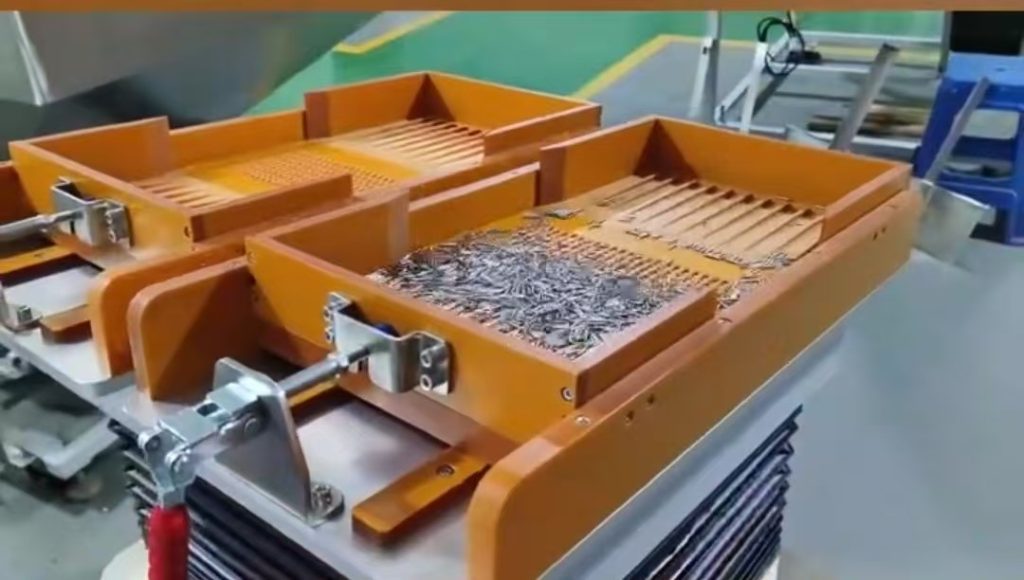
• In the field of connector production, the quality of the whole row of precision parts such as terminals and pins directly determines the electrical performance and service life of the product. Taking mobile phone Type-C interface and automotive high-voltage wiring harness connector as examples, the size of the terminals and pins is usually between 0.1-1mm, and the traditional manual sorting or extensive arrangement method is not only inefficient, but also more prone to deformation of parts, wear of plating, and other failures due to operation errors. With sophisticated automation technology, the automatic part aligner has become the core equipment to solve this problem.
•
Modern connector aligners mostly use a variety of technologies such as “vibration arrangement + visual inspection + deviation correction”. First, through the customized track and fixture plate, the parts are naturally separated and initially oriented by high-frequency vibration. The machine then uses an industrial camera with a high resolution of 20 million pixels to dynamically scan the parts that have passed through the inspection station. The AI vision algorithm can identify defects such as the positive and negative directions of the terminals, the bend angle of the pins, and surface scratches in 0.3 seconds with an accuracy of ±10 microns. If a part with an incorrect attitude is detected, the system immediately triggers a pneumatic paddle or electromagnetic baffle to divert it to the rework channel.
•
Finally, the secondary attitude calibration of the parts is carried out through the precision deviation correction mechanism driven by the servo motor. For terminals in automotive connectors that require a specific angle insertion, the aligner uses a rotating gripper with laser positioning to ensure that the angular error of the part before entering the pin device is controlled within ±0.5°. In the collaborative operation with the automatic pin insertion equipment, the automatic part aligner communicates with the pin inserter in real time through the industrial bus (such as Profinet) to supply the pin insertion machine stably at a speed of 10-20 pieces per second, which is more than 5 times more efficient than the traditional manual feeding, and the defect rate is reduced from 3%. 0.2% or less.
•
In addition, the modular design of the whole column machine can quickly switch between different specifications of tooling and fixtures to meet the production needs of connectors in mobile phones, automobiles, communications and other fields. According to the application case of a leading connector manufacturer, after the introduction of the intelligent alignment system, the insertion capacity of automotive high-voltage wiring harness connectors has increased from 800 pieces per shift to 4,500 pieces, and the rework cost caused by part attitude error has been reduced by 85%, which has significantly enhanced the competitiveness of the product in the new energy vehicle market.