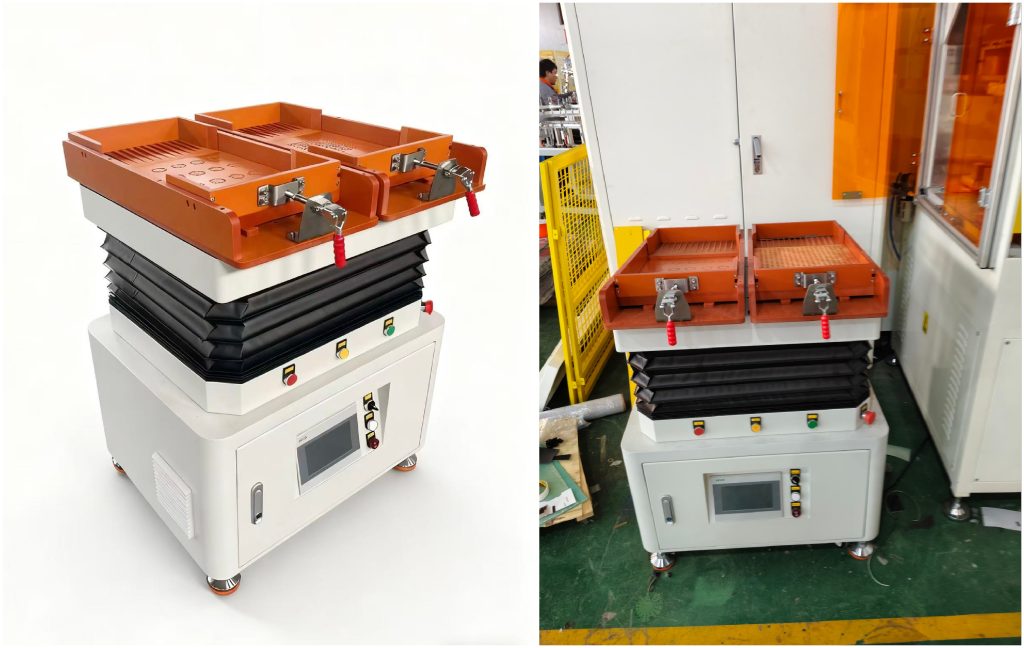
Recently, has your social media feed been flooded with the “SBTI” test? Touted with the slogan “MBTI is outdated, SBTI is here,” this personality test uses self-deprecating labels like “the deceased,” “stunner,” and “macaque” to strike a chord with young people, sparking a new round of online buzz. But behind the scenes of precision manufacturing, another piece of equipment is quietly disrupting traditional production models—the part aligner machine.
In the manufacturing of precision products like mobile phone chips and automotive connectors, arranging tiny components has always been a major headache. Traditional methods relying on manual visual inspection and hand placement are not only inefficient and inconsistent but also face challenges such as labor shortages and continuously rising labor costs. Today’s part aligner machines have evolved into a “super brain” that combines micro-vibration, AI vision, and high-precision tooling, effortlessly achieving repeat positioning accuracy of 0.05mm.
If the SBTI test breaks the obsession with “elite personalities” through self-mocking labels, the part aligner machine overturns the labor-intensive production logic with its hardcore capabilities. Let’s do the math: a single automatic part aligner machine can roughly match the output of five to six skilled operators. It doesn’t get tired and can run 24/7 non-stop, serving as a stabilizing anchor for companies facing labor shortages.
Even more exciting is that Chinese-made equipment is accelerating its global expansion. Recently, several domestic automation equipment manufacturers have exported multiple batches of high-end part aligner machines to Vietnam and other Southeast Asian countries, where they are used in local electronics manufacturing and automotive parts industries. This marks a shining golden name card for “Intelligent Manufacturing in China” amid the global wave of smart industrialization. Riding the wave of Industry 4.0, the part aligner machine, with its ultimate precision alignment art, safeguards quality standards across sectors from electronic semiconductors to new energy vehicles.